

Product listings for phenibut use two abbreviations again and again: HCl and FAA. They describe two chemical forms of the same parent molecule, and the difference is real chemistry, not marketing. This article explains what each form is, how they differ on paper, which identifiers belong to which form, and how to read a label so you know exactly what is in the container. It covers chemistry and labeling only. It does not discuss effects or use.
All Phenilab phenibut products, including the Phenibut HCl powder, contain the hydrochloride form. Knowing why that matters starts with the parent molecule.
The parent molecule
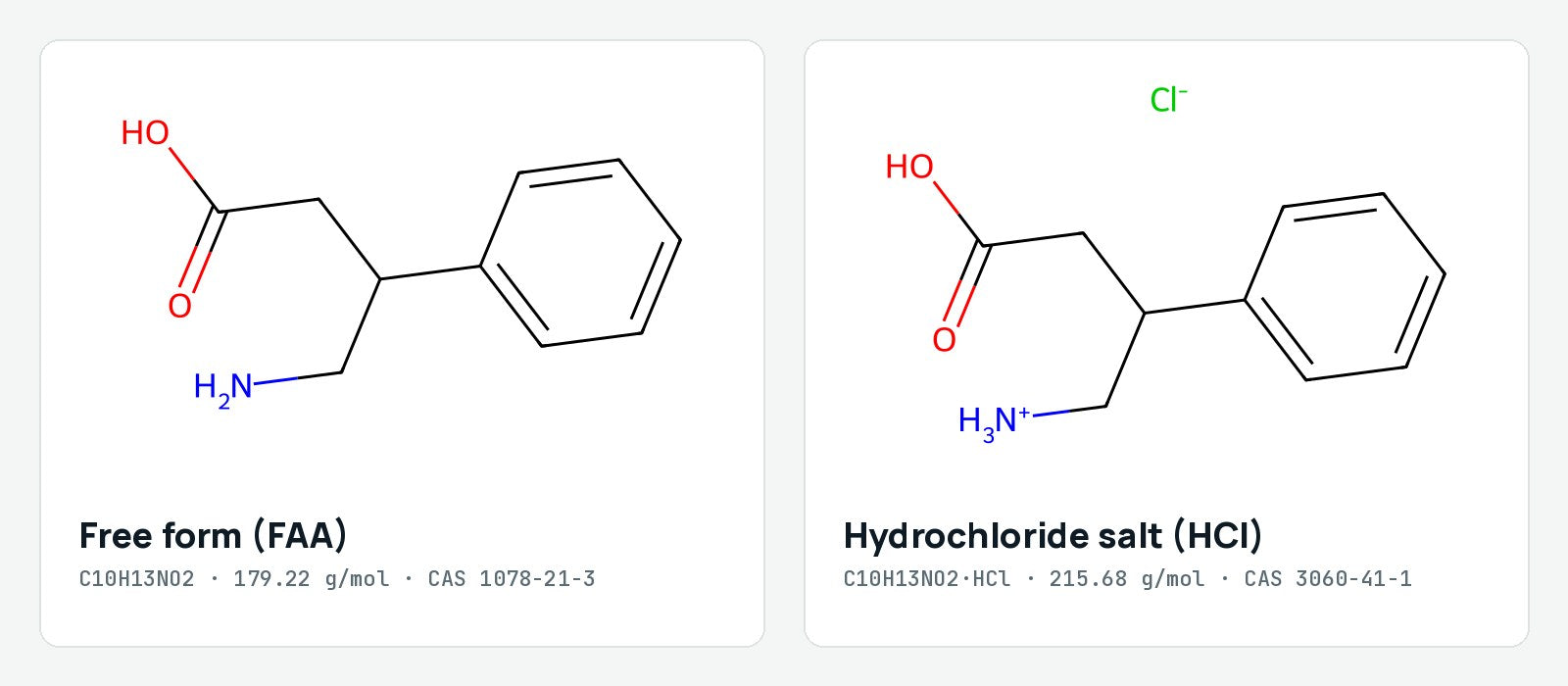
"Phenibut" is the common name of 4-amino-3-phenylbutanoic acid. Its molecular formula is C10H13NO2, its molar mass is 179.22 g/mol, and its monoisotopic mass is 179.0946 Da. Structurally, it is a four-carbon butanoic acid chain with two attachments: a phenyl ring (a benzene ring) on carbon 3 and an amino group (–NH2) on carbon 4. You may also see it described as β-phenyl-γ-aminobutyric acid, or β-phenyl-GABA, because it is the GABA backbone with a phenyl group at the beta position.
Two functional groups matter for this article:
- The carboxylic acid group (–COOH), which can give up a proton.
- The amino group (–NH2), which can accept a proton.
A molecule with both an acidic and a basic group is amphoteric, and that is the key to understanding the difference between the two forms.
A note on stereochemistry
Carbon 3 carries four different substituents, so it is a stereocenter, and phenibut exists as two mirror-image forms, (R) and (S). The general identifiers used in this article, including the standard InChIKey DAFOCGYVTAOKAJ-UHFFFAOYSA-N, describe the compound without specifying stereochemistry. That is normal for product labeling, but it is worth knowing that a single-enantiomer material would carry different identifiers.
What "FAA" means
FAA stands for "free amino acid." It is a market label, not a pharmacopoeial or IUPAC term. Chemists would usually call this the free form or, less precisely, the free base. Both terms describe the molecule on its own, without a counterion.
Like other amino acids, the free form contains both an acidic and a basic group in the same molecule, so it can exist as a zwitterion, where the carboxylic acid has given its proton to the amino group. The molecule then carries a positive and a negative charge at the same time while staying neutral overall. This internal salt is the reason amino acids generally behave differently from simple organic acids or simple amines when it comes to melting behavior and solubility.
Key identifiers for the free form:
- Name: 4-amino-3-phenylbutanoic acid
- Formula: C10H13NO2
- Molar mass: 179.22 g/mol
- CAS Registry Number: 1078-21-3
What "HCl" means
HCl is the chemical formula of hydrogen chloride. When phenibut is combined with hydrochloric acid, the amino group is protonated (–NH3+) and a chloride ion (Cl–) balances the charge. The result is phenibut hydrochloride, an acid addition salt.
Key identifiers for the hydrochloride:
- Name: 4-amino-3-phenylbutanoic acid hydrochloride
- Formula: C10H13NO2·HCl (also written C10H14ClNO2)
- Molar mass: 215.68 g/mol
- CAS Registry Number: 3060-41-1
Where the extra mass comes from
The molar mass of the salt is simple arithmetic. Hydrogen chloride has a molar mass of about 36.46 g/mol. Add that to 179.22 g/mol and you get 215.68 g/mol. The parent molecule is the same in both forms; the salt simply carries one equivalent of HCl with it.
This is why a label must say which form it refers to. A gram of the hydrochloride and a gram of the free form are not the same material, so a weight on its own does not tell you what is in a capsule. The form has to be stated alongside it.
Why chemists make salts at all
Turning an amine-containing molecule into a hydrochloride is one of the most common steps in pharmaceutical chemistry. A 2018 review in the journal Molecules reports that roughly half of FDA-approved active ingredients are salts, and it lists hydrochloride first among the most common counterions for basic compounds over the past two decades. The review explains several reasons for choosing a salt form:
- Solubility. Salt formation is one of the most widely used methods for raising the water solubility of weakly acidic and weakly basic compounds.
- Solid-state properties. Salts can raise a compound's melting point and help keep it as a stable solid.
- Crystallinity and handling. Crystalline material is generally preferred in manufacturing because it flows, weighs and processes more predictably.
The same review also notes trade-offs. Salts of strong mineral acids are very polar, which can raise hygroscopicity, meaning the tendency to take up moisture from the air, and can lower the local pH. Neither form is "better" in an absolute sense. Each has a different physical profile.
Solubility and handling as chemistry facts
Several practical points follow from the chemistry.
In water
Phenibut hydrochloride is the salt of a weak base and a strong acid. When it dissolves in water, the solution is acidic. The free form, as a zwitterionic amino acid, behaves differently in water, and its solubility depends strongly on pH. Published supplier figures vary with temperature, pH and method, so for exact values the batch's own data sheet is the right reference, not a generic number from the internet.
In storage
Because salts of mineral acids can be hygroscopic, fine powders of hydrochloride salts should be kept in a tightly closed container, away from humidity and direct heat. In the UAE climate that is especially relevant: a powder left open in a humid bathroom will behave differently from one kept sealed in a cool cupboard.
Appearance
Both forms are solids at room temperature, and appearance alone cannot tell one chemical form from another. Identification requires analytical methods, which is why a certificate of analysis matters more than how a powder looks.
How to read a label: a checklist
A label that is clear about chemical form answers the following questions without you having to guess.
- Which form is it? Look for "hydrochloride," "HCl," "free amino acid," "FAA" or "free form" next to the name. "Phenibut" alone is ambiguous.
- Which CAS number is given? 3060-41-1 indicates the hydrochloride; 1078-21-3 indicates the free form. If a product says "HCl" but quotes only 1078-21-3, the label is mixing references. Some listings give both numbers for context, which is fine as long as the form actually contained is stated clearly.
- Does the weight refer to the form in the container? A clear label states the weight of the form actually present, for example "500 mg phenibut HCl per capsule."
- Does the molecular formula match? C10H13NO2·HCl for the salt, C10H13NO2 for the free form.
- Is there a LOT number? The LOT links the container to a specific batch and its test report.
- Does the COA name the same form? The certificate of analysis should identify the same form that is on the label. A mismatch between label and COA deserves a question to the seller.
Our guide on how to read a certificate of analysis walks through the second half of this checklist in detail.
Example: reading a Phenilab label
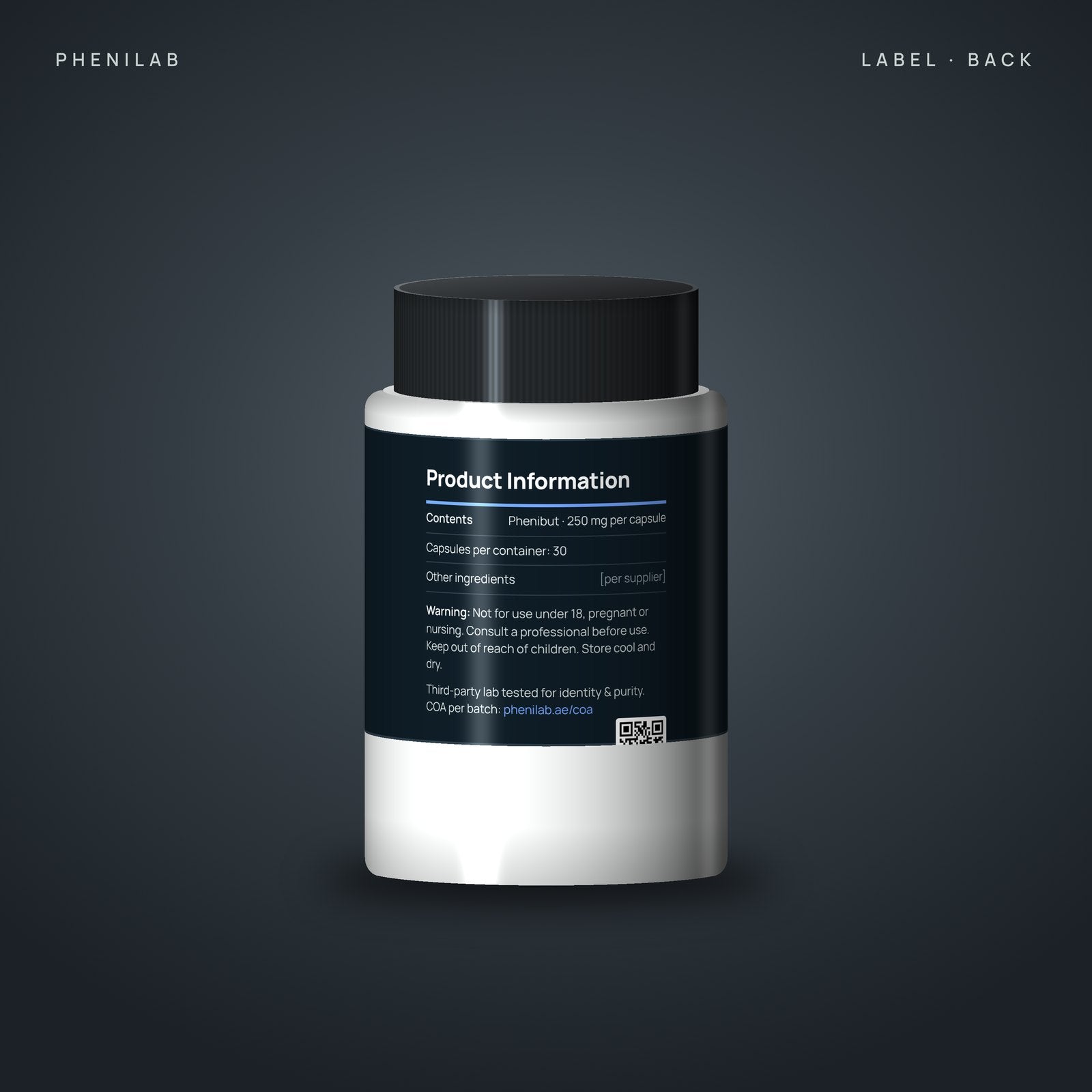
On the Phenibut 250 mg capsules page, the product data table states "Capsules, each containing 250 mg Phenibut HCl." The same table lists both CAS numbers, each tagged with its form (free base and HCl), and both molar masses, again tagged. The form in the capsule is unambiguous: the hydrochloride. The batch's LOT number connects the jar to its certificate.
Common misconceptions
"FAA is a different compound"
It is not. The free form and the hydrochloride share the same parent molecule. The difference lies in whether a hydrogen chloride counterion is present, which changes the solid's mass, solubility behavior and handling, not the identity of the organic molecule.
"The CAS number is the same for both"
It is not. CAS assigns separate Registry Numbers to the free form (1078-21-3) and the hydrochloride (3060-41-1). A seller quoting one number for both forms is being imprecise.
"Purity percentages compare directly across forms"
A purity result always refers to a specific reference substance and method. If one certificate reports purity of the hydrochloride and another reports purity of the free form, the two numbers are measuring against different references. Our article HPLC explained for buyers shows how such numbers are generated.
For a broader look at how the shop presents product information, see the full nootropics collection.
Frequently asked questions
What is the difference between phenibut HCl and phenibut FAA?
Phenibut HCl is the hydrochloride salt (C10H13NO2·HCl, 215.68 g/mol, CAS 3060-41-1). Phenibut FAA is the free amino acid form (C10H13NO2, 179.22 g/mol, CAS 1078-21-3). The organic molecule is the same; the salt also carries one equivalent of hydrogen chloride.
Is "FAA" an official chemical term?
No. It is a market abbreviation for "free amino acid." Chemists usually say free form or free base.
Which form do Phenilab products contain?
All Phenilab phenibut products contain phenibut hydrochloride (HCl). This is stated on each product page.
How can I tell the forms apart by looking at them?
You cannot reliably do so. Both are solids, and appearance is not an identification method. The label, CAS number and certificate of analysis are what identify the form.
Why do some listings give two CAS numbers?
Some listings give both numbers for reference. That is acceptable when each number is tagged with its form and the label clearly states which form is in the container.
Sources
- PubChemLite: 4-amino-3-phenylbutanoic acid (formula, monoisotopic mass, InChIKey)
- Phenibut: chemical data and CAS numbers, Wikipedia
- Gupta D, et al. Review article on pharmaceutical salts. Molecules 2018;23(7):1719
Information in this article is general and is not medical advice.